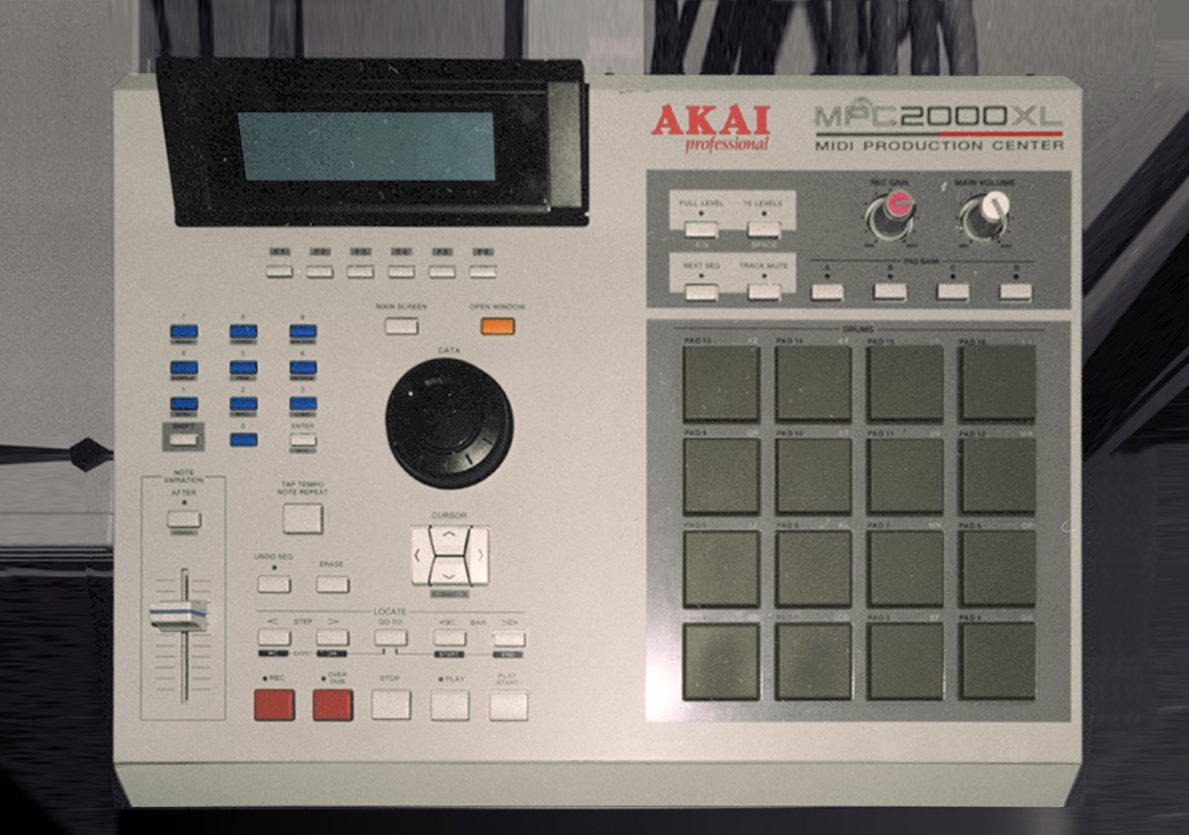
A sampler is an instrument that records a sound, stores it as digital audio and plays it back when you press a pad or a key. The sound can be anything that reaches its input: a single snare hit, a spoken word, one note on a piano or four bars of drums from a funk record. A drum machine also plays drums when you tell it to, but it brings its own sounds. On a sampler, you supply the sound yourself.
A sampler records a sound and plays it back on command
Everything a sampler does starts with a recording. Sound comes in through a microphone or line input and is turned into a long series of numbers in the sampler’s memory. You then set where the sound starts and where it ends, and assign it to a pad or a key. Press the pad and the sampler plays those numbers back as sound, the same way every time.
Because the sound is stored as data, the sampler can change how it plays it. Played back faster, a sample gets higher in pitch and shorter. Played back slower, it gets lower and longer. That is how a keyboard sampler turns one recorded note into a playable instrument: each key plays the same recording at a different speed. It is also how a producer can tune a kick drum down or speed up a break, a technique called repitching.
A sampler can also cut a recording into pieces. A loop of drums can be split into single hits: one kick, one snare and one hi-hat, each on its own pad. Played in a new order, the pieces make a new beat that still sounds like the original drummer in the original room.
A drum machine plays its own sounds in a pattern you program
A drum machine combines a set of built-in drum sounds with a sequencer, the part that stores a pattern and plays it back in time. You program which sound plays on which step, and the machine repeats the pattern for as long as you let it.
On early drum machines the sounds were synthesized by electronic circuits rather than recorded. The Roland TR-808 was all analog. Roger Linn, who designed the LM-1 Drum Computer in 1979, describes the synthesized drum sounds common on early drum machines as poor in quality. The LM-1 played digital samples of real drums instead.
Those samples came from the factory, though. The owner could program beats but not record new sounds into the machine. Its successor, the LinnDrum, added changeable sound chips, so a new drum sound meant a new chip. Recorded sounds alone do not make a drum machine a sampler. What makes it a sampler is that the owner can record into it.
The Roland TR-909 mixed analog drums with recorded hi-hats and cymbals
The Roland TR-909 from 1983 used both kinds of sound: synthesized drums and recorded cymbals. For the TR-909, Roland was still pursuing the idea of an analog “drum synthesizer” rather than “a machine that played back digital samples of ‘real’ drums,” the company writes in its history of the machine. The analog sounds gave the user extensive control, such as the option to detune the kick drum or the toms.
The hi-hats and cymbals were different. Roland decided they “should be digital recordings of their acoustic counterparts,” because the engineers felt a more realistic sound would help the TR-909 feel like a substantial upgrade over the TR-808. Those recordings sat in the machine’s sample ROM, a read-only memory, so the owner could play them but not record new ones.
So the TR-909 played samples without being a sampler. In the small studios of the time, the drum machine and the sampler were separate boxes. The TR-909 was Roland’s first drum machine with MIDI, a standard that let electronic instruments control each other. With MIDI, a drum machine, a sampler and effects processors could work as one setup, with the drum machine’s sequencer driving the sampler.
Sampling drum machines let you record your own sounds
The next step was a drum machine that could record its own sounds. Linn’s 1984 Linn 9000 let the owner sample sounds, and it added velocity-sensitive drum pads and a MIDI sequencer. The owner could now sample a snare from a record and program it into a beat on the same machine.
E-mu’s SP-1200 worked the same way, and its limits show how scarce memory was. Its designer, Dave Rossum, built the sound engine in 1984 to hold 20 seconds of sound, but in 1987 the cost of memory limited the production units to 10 seconds, according to his company, Rossum Electro-Music. A single sound could be no longer than 2.5 seconds. The machine recorded at 12 bits and 26.04 kHz, and its pitch shifting leaves audible artifacts, called aliasing and imaging, that are part of its character. With so little time, the length of a bar at a given tempo decided how much of a break a producer could keep.
In 1988 Linn designed the MPC60 MIDI Production Center for Akai. It combined a sampling drum machine with a real-time MIDI sequencer, recorded at 12 bits and could play 16 sounds at once. It gradually became the industry standard for hip-hop and dance music production in the 1990s, according to Linn’s company. Hip-hop musicians used its swing feature and played its touch-sensitive pads dynamically to make very natural-sounding beats, Linn writes.
Loading a drum break onto MPC pads is a sampler’s job
A producer who loads a drum break into an MPC and plays it on the pads is using the sampler half of the machine. The break was recorded from somewhere else, trimmed, perhaps cut into single hits, and assigned to pads. No drum machine with fixed sounds can do that, however good its built-in kit is.
For hip-hop producers in the mid-1980s, sampling changed how breaks were used. Once a few seconds of a record could be recorded and repeated by a machine, a break no longer had to be looped by hand on two turntables. Producers could take the drums from a 1969 soul B-side and rebuild them into a new pattern.
A drum machine plays the sounds it was built with, whether they come from analog circuits, from recordings in ROM or, as on the TR-909, from both. A sampler plays whatever you record into it. The MPC is both: a drum machine whose sounds come from its own sampler.
Last fact-checked: 23 November 2026